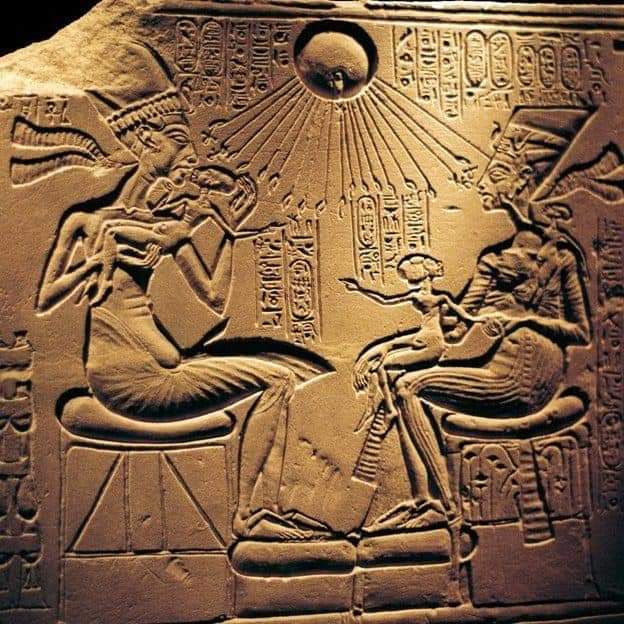
NEFERTlTl Queen consort of Egypt Great royal bride In office 1351 BC – 1334 BC or 1353 BC – 1336 BC Predecessor Tyi (Grand Royal Bride of Amenhotep III) Successor Merytaton (Great Royal Bride of Smenkhara) Full name: Neferneferuaton Nefertiti Birth ca. 1370 BC Akhetaton’s death, 1330 BC XVIII dynasty of Egypt Father Ay? Consort Akhenaton Children: Merytaton, Maketaton, Ankhesenpaaton, Neferneferuaton Tasherit, Neferneferura, Setepenra Religion Atonism “Pleasant to behold, as beautiful as the Two Feathers, lady of joy, giver of grace, which gives happiness to those who hear her voice.” Great royal wife of pharaoh Akhenaten (1351 BC-1334/3 BC), she joined her husband in the great but ephemeral religious revolution that tried to impose the cult of the only god Aten, the solar disc. Together, Akhenaten and Nefertiti were responsible for the creation of a new henotheistic religion that caused upheavals within the ancient Egyptian religion and some political unrest for twenty years. Her reign alongside Akhenaten began in the period of greatest prosperity in Egyptian history (inaugurated with Amenofi III, Akhenaten’s father) to end in a momentary disintegration of the country, with revolts fomented by the clergy of Amon, and in an imminent crisis. dynastic. No other Egyptian queen appears as firmly linked to her husband’s throne as Nefertiti: the representations of her alongside Akhenaten conferred on her hitherto unmatched honors, as well as the numerous scenes of intimacy and affection of the royal couple that have reached today. Some Egyptologists believe that Nefertiti reigned briefly as Neferneferuaton after the death of her husband (ca. 1334 BC) and before the accession of Smenkhara and Tutankhamun (ca. 1332 BC); however, the identification of Neferneferuaton with Nefertiti is the subject of an extremely complex archaeological debate. Names (Nfr nfr.w Jtn), Neferneferuaton, ie “Wonderful is the beauty of Aten”, follows the most famous nomen (Nfr.t jj tj), Nefertiti, that is “The beauty has arrived”. Family Nefertiti’s parents are not known for certain, although a fairly widespread theory has it that her father was the high official Ay, destined to succeed Tutankhamun. This theory is opposed by scholars who point out that Ay’s wife, the noblewoman Tey, had the title of Nurse of the Great Queen (Nefertiti), and therefore could not have been her mother, although others suggest that the mother of Nefertiti was a wife of Ay prior to Tey. Scenes inside Akhetaton’s royal tombs, depicting Nefertiti, mention a sister named Mutbenret (whose name was formerly read as Mutnodjemet). Another theory would identify Nefertiti with the Mitannic princess Tadukhipa, daughter of king Tushratta, but sent to Egypt to marry the now elderly Amenofi III. However, there is no evidence for Nefertiti’s possible foreign origin, nor as to why she should have changed her name. The exact date of Akhenaten and Nefertiti’s wedding is not known. Their six daughters (and possible years of their birth) were: Princess Merytaton, 1st year of reign (strong candidate for identification with Neferneferuaton); Princess Maketaton, 4th year of reign; princess Ankhesenpaaton (later Ankhesenamon); Princess Neferneferuaton Tasherit, 8th year of reign; princess Neferneferura, 9th year of reign; Princess Setepenra, 11th year of reign. The inscriptions always indicate Nefertiti as the mother of the six princesses, never designating Akhenaten as her father. This very unusual detail has given rise to theories that Akhenaten was sterile and the six princesses, in fact, daughters of Amenhotep III. Wikipedia

 Breaking news