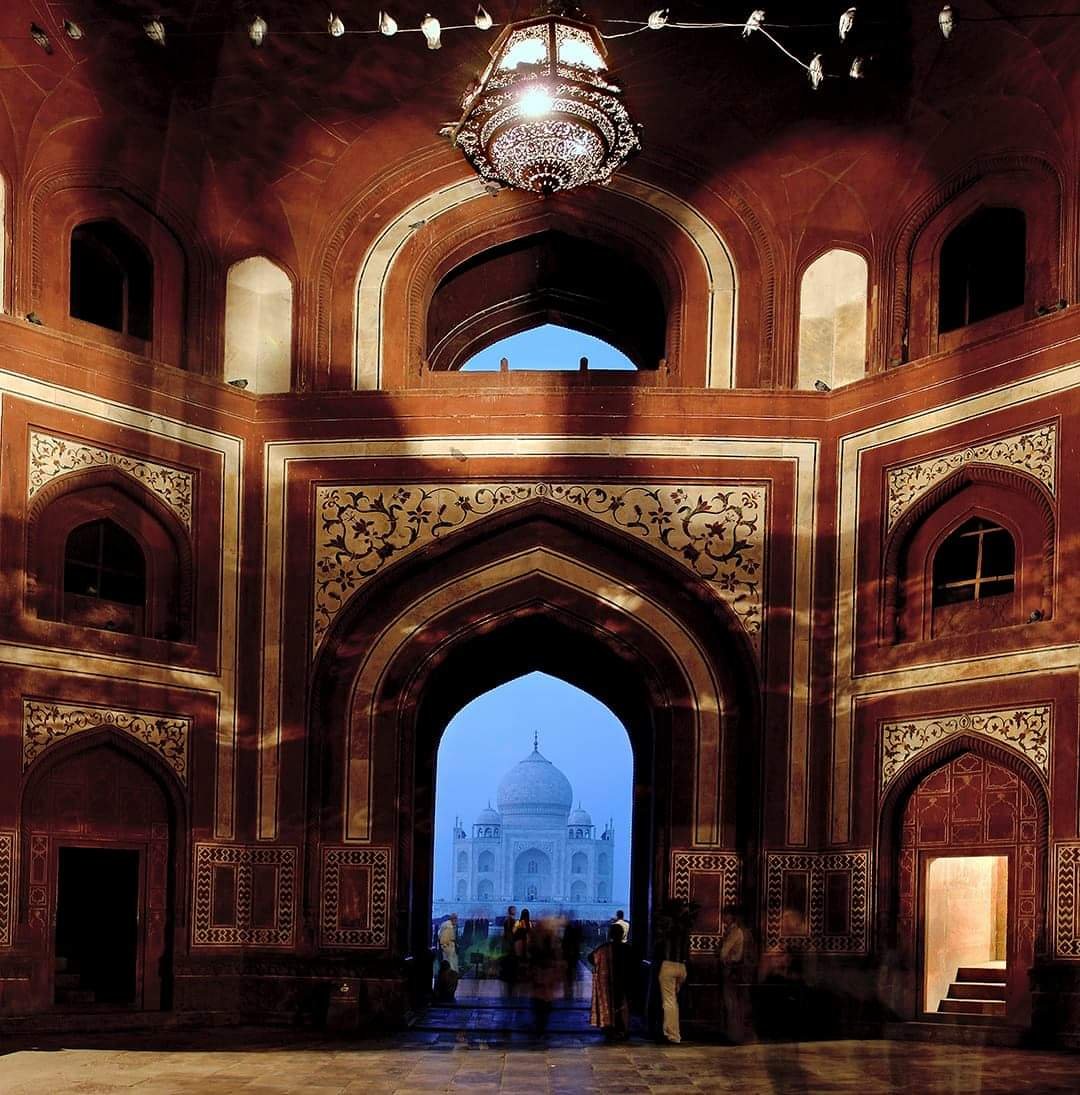
This immense gateway is rich with significance. It marks the transition from the secular to the sacred. Notionally, the gate could be interpreted as the threshold between the earthly world and the aspiration inside, the arched entrance marking the point of transition. The Taj Mahal was undoubtedly conceived as a sacred space, built in perfect cardinal direction and on axis; every view of the Taj Mahal is defined by perfect alignment. Here from the southern entrance, now erroneously called the main gate, is from where the public could view Jannat. In its day, no common person could enter the gardens and view the mausoleum inside. And yet from here, the Taj can be viewed in all its glory, its scale and its perfection as an illumined tomb seated in a sandstone walled garden, punctuated with buildings on either side. Jannat was to be seen from a distance, through the paradise gardens where permanent shade, fruit, fragrant flowers and running water would be the canvas for the illumined tomb. The entrance to this gate was from the Jillau Khana and beyond the south gate, which led into the great serais and bazaars that had been built as part of the grand plan. The paradise garden was replaced a hundred years ago with English lawns; the monument was laid bare, no longer a sacred space shrouded in metaphor and allegory, secluded within a paradisical garden. Over time, the Taj Mahal has been desecrated by invaders, marauders and today it is has a reductionist perception as a tourist attraction, a monument of love, its many narratives lost in the cacophony of the crowds which throng the immortal structure. TAJ MAHAL, AGRA, UTTAR PRADESH Thought by ILF Expert Amita Baig

 Breaking news